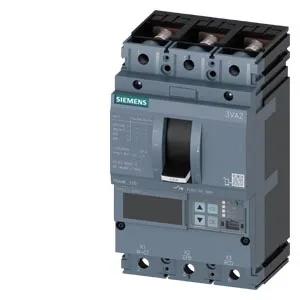
SENTRON 3VA2010-5JQ32-0JC0 — 100 A MCCB with ETU560 Trip Unit
The Siemens SENTRON 3VA2010-5JQ32-0JC0 is a 3-pole molded case circuit breaker rated for a continuous current Iu of 100 A at 40 °C, with the ETU560 electronic trip unit providing adjustable protection curves for line (cable/feeder) protection. The breaker carries a 187 kA interrupting capacity at 240 V AC, dropping to 121 kA at 415/440 V, 79 kA at 500 V, and 3.4 kA at 690 V — the high-end short-circuit rating at 240 V makes this unit suitable for applications with very high available fault current, such as large transformer secondaries or main service entrances where the SCCR exceeds what a standard 65 kA or 100 kA MCCB can handle.
The interrupting capacity of 187 kA at 240 V AC is the headline number, but the engineer specifying this breaker into a 400 V or 480 V system needs to look at the 415/440 V rating of 121 kA and the 500 V rating of 79 kA. These are the numbers that govern coordination with downstream breakers and the upstream transformer's impedance-limited fault current. The 690 V rating drops sharply to 3.4 kA — this breaker is not intended for 690 V main service; it is a 240–500 V device with a token 690 V rating for low-fault applications only. The ETU560 electronic trip unit offers adjustable long-time pickup (Ir), short-time pickup (Isd), instantaneous pickup (Ii), and ground-fault protection. This is a line-protection variant, not a motor-protection variant, so it does not include phase-failure detection (that is handled by the upstream protection or motor starter).
Thermal Derating and Operating Envelope
Above 50 °C, derating applies linearly: 96.25 A at 55 °C, 92.5 A at 60 °C, 88.75 A at 65 °C, and 85 A at 70 °C (the maximum operating temperature). If the panel ambient hits 60 °C, the breaker can only carry 92.5 A continuously without nuisance tripping. Maximum power loss is 13.5 W — factor this into panel thermal dissipation calculations, especially in sealed enclosures.
Auxiliary Components and Communication
The breaker ships with 2 HQ auxiliary switches (form C, high-rupturing-capacity contacts) for remote status indication of the main contacts. The integrated auxiliary trip is a separate order code 3VA9688-0BL32; the basic switch (the core switching mechanism without the trip unit) is 3VA2010-5JQ32-0AA0. The communication function is present on this variant — this typically means a communication-capable ETU or an optional communication module interface, enabling integration with a BMS or SCADA system for remote monitoring and trip-event logging. The undervoltage release is not fitted on this variant; if UVR is required for your safety circuit, specify a different option or add an external undervoltage relay.