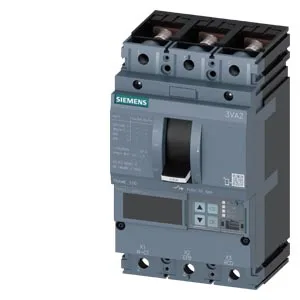
The Siemens SENTRON 3VA2010-5JQ32-0KL0 is a 3-pole molded case circuit breaker rated for 100 A continuous current at 40 °C, with an interrupting capacity of 187 kA at 240 V and 121 kA at 415 V — numbers that tell you it's built for high-fault service entrances or large distribution panels where the available fault current is serious. That means you can remote-trip it from a PLC or E-stop circuit, and get status feedback — trip alarm, breaker open/closed — back to the control system. No undervoltage release is fitted, so if you need UVR for a safety circuit, this variant isn't the one; you'd look at a -0KL0 with a different auxiliary release code. Communication is on board — the ETU560 supports the SENTRON communication module for PROFIBUS or PROFINET, letting you read current, power, and energy data from the breaker. That makes it useful for an energy monitoring scheme or a predictive-maintenance dashboard, not just a dumb overcurrent protector.
Above that, it derates: 96.25 A at 55 °C, 92.5 A at 60 °C, 88.75 A at 65 °C, and 85 A at 70 °C.
It's a fixed-mount MCCB — no draw-out cradle — so it bolts directly to the panel backplate or mounts on a DIN rail adapter (Siemens offers a separate adapter for the 3VA2 frame). The 105 mm width is the standard 3-pole frame width for this series; if you're replacing a 3VA1 or older 3VL breaker, check the mounting hole pattern and busbar spacing — the 3VA2 footprint is close but not identical to the 3VA1.
The 3VA1110-5EE32-0JA0 is a 3-pole 100 A MCCB from the same SENTRON family, but it's a 3VA1 frame — physically smaller (shorter and narrower) and with a lower interrupting capacity (typically 65 kA at 240 V vs. 187 kA for this 3VA2). The 3VA1 uses a simpler thermal-magnetic trip; this 3VA2 has the ETU560 electronic trip with communication and ground-fault. If your panel was specced around the 3VA1110, the 3VA2010 is wider and deeper, so it won't drop into the same mounting footprint without drilling new holes and checking busbar alignment. The electrical performance is a step up, but the mechanical swap isn't trivial.