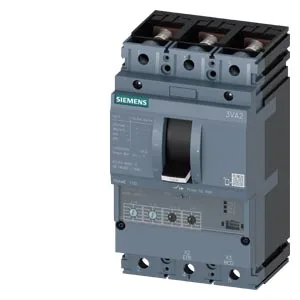
What this MCCB is and what it does
The Siemens SENTRON 3VA2010-6HN32-0BC0 is a 3-pole molded case circuit breaker (MCCB) rated for line protection, carrying a continuous current Iu of 100 A and a rated insulation voltage Ui of 800 V. It ships with an ETU350 electronic trip unit and an integrated undervoltage release (UVR) — the UVR coil is the 3VA9608-0BB11 auxiliary trip, and the breaker includes two HQ auxiliary switches as standard. The breaking capacity at 240 V is 242 kA, at 415 V it is 187 kA, and at 690 V it drops to 4 kA — so on a 400 V class panel this breaker handles high fault currents typical of transformer-fed distribution.
Thermal derating and enclosure fit
The breaker is rated 100 A from 40 °C through 50 °C; above that it derates linearly to 85 A at 70 °C. In a closed panel with ambient near 55 °C, expect 96.25 A continuous — so a 100 A feeder should be loaded to about 96 A if the panel runs warm. The footprint is 105 mm wide, 181 mm tall, and 86 mm deep — standard for a 100 A frame SENTRON MCCB. Mounting is screw-fixed to a backplate or DIN rail adapter; the depth leaves clearance for rear-access busbars in a typical 600 mm deep enclosure.
What the ETU350 release and undervoltage release mean for coordination
The ETU350 is an electronic trip unit offering adjustable long-time, short-time, instantaneous, and ground-fault protection curves — it is the same platform used across the 3VA2 frame, so coordination studies with downstream breakers are repeatable. The undervoltage release (UVR) trips the breaker when control voltage drops below a set threshold, which is standard for emergency-stop circuits or undervoltage protection on motor feeders. The breaker does not include a voltage trigger, phase failure detection, or communication function — it is a standalone protective device, not a smart breaker.
