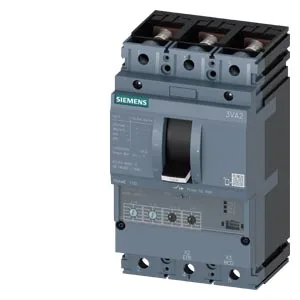
The Siemens SENTRON 3VA2010-6HN32-0KH0 is a 3-pole molded case circuit breaker (MCCB) rated for 100 A continuous current across the full ambient range from 40 °C to 70 °C — no derating needed up to that ceiling. At 690 V the rating drops to 3 kA, so this is not a 690 V main breaker — keep it on the 240–500 V side for full fault-clearing capability.
The shunt trip lets a remote signal — from an E-stop, fire alarm, or PLC safety output — open the breaker electrically without someone at the handle. The auxiliary switches report the breaker's open/closed state back to a control system, and the trip alarm flags that it opened on a fault, not manually. No undervoltage release is fitted, so if you need UVR for a motor starter interlock, this is not the order code.
Dimensions are 181 mm high, 105 mm wide, 86 mm deep — a standard 3-pole MCCB footprint that fits most DIN-rail or panel-mount enclosures sized for 100 A frames. No communication module or ground-fault monitoring is built in; this is a straight thermal-magnetic or electronic trip unit for line protection only.