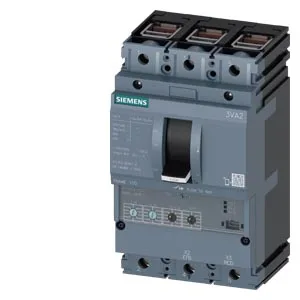
What this MCCB delivers on the line side
The Siemens SENTRON 3VA2010-6HN36-0BA0 is a 3-pole molded case circuit breaker (MCCB) rated for 100 A continuous current across its full operating range of -25 °C to 70 °C — no derating needed up to that ceiling. That 100 A holds steady at 40 °C, 50 °C, even 70 °C, which means you can load it to nameplate in a warm panel without recalculating the thermal curve. Breaking capacity is the headline figure here: 242 kA at 240 V, 187 kA at 415 V and 440 V, 121 kA at 500 V, and 3 kA at 690 V. That 242 kA at 240 V puts it well into the high-fault tier — suitable for service-entrance or main feeder duty where available fault current is substantial. The 3 kA at 690 V looks low by comparison, but that's typical for a 100 A frame at that voltage; the real-world application for this part is at 240–500 V. It carries an undervoltage release (UVR) as standard — the auxiliary release type is explicitly an undervoltage release, so it will trip if control voltage drops below a threshold. No trip indicator, no voltage trigger, no communication module, and no ground-fault monitoring built in. This is a straightforward line-protection device, not a multifunction power monitor.
Panel fit and integration
Dimensions: 105 mm wide, 181 mm high, 86 mm deep. That 86 mm depth is the body depth behind the panel face — check your enclosure depth before committing, especially if you're retrofitting into an existing backpanel with limited clearance. The 105 mm width is a standard 3-pole MCCB footprint for this class; it mounts on a DIN rail or direct-panel bolted connection depending on the accessory kit used. Rated insulation voltage is 800 V, so the internal clearances and creepage are designed for that level. Power loss at full load is 16 W maximum — modest for a 100 A frame, but worth accounting for in a sealed enclosure with multiple breakers side by side.
Lifecycle and sourcing posture
The basic switch assembly inside this breaker is order code 3VA20106HN360AA0 — useful to know if you're ordering spare internal parts or validating a replacement subassembly.
