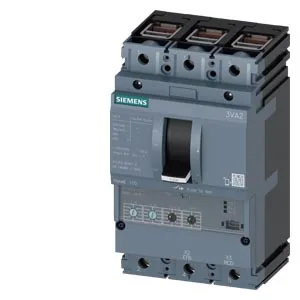
What the ratings mean for your panel
The Siemens SENTRON 3VA2010-6HN36-0BC0 is a 3-pole molded case circuit breaker (MCCB) rated for 100 A continuous current (Iu) without derating up to 50 °C — above that, it steps down to 96.25 A at 55 °C, 92.5 A at 60 °C, 88.75 A at 65 °C, and 85 A at 70 °C, so plan your thermal budget if the breaker sits in a hot enclosure. The ETU350 electronic trip unit gives you adjustable overload and short-circuit protection curves, which means you can fine-tune coordination with downstream breakers instead of swapping fixed-trip units. Breaking capacity hits 242 kA at 240 V AC and 187 kA at 415/440 V, then drops to 121 kA at 500 V and 4 kA at 690 V — the 240 V figure is the headline, but the 415 V rating is the one that governs most industrial distribution panels in Europe and Asia. Rated insulation voltage is 800 V, so it's rated for 690 V line-to-line systems with margin. The undervoltage release (UVR) is included — part number 3VA9608-0BB11 — and the auxiliary contact block carries 2 HQ switches for status feedback to a PLC or annunciator panel. No communication module, no ground-fault monitoring, no phase-failure detection on this variant; it's a straight line-protection breaker with electronic trip and remote undervoltage shunt capability.
Panel fit: dimensions and integration
Mounts with 105 mm width, 181 mm height, and 86 mm depth — standard 3-pole MCCB footprint that fits most DIN-rail or screw-mount panel layouts. The 86 mm depth leaves room for rear-connected busbars or cable lugs in a shallow enclosure. Operating temperature range is -25 °C to 70 °C; storage range is -40 °C to 80 °C. Maximum power loss is 16 W at rated current — negligible for most cabinets, but worth noting if you're packing multiple breakers in a sealed enclosure with no forced ventilation.
Undervoltage release and auxiliary contacts
The integrated undervoltage release (UVR) trips the breaker when control voltage drops below a threshold — essential for safety circuits where a loss of control power must open the main disconnect. The 2 HQ auxiliary switches provide independent NO/NC contacts for remote status indication; they're wired separately from the main power path, so the PLC sees the breaker state even if the UVR has already opened it. No voltage trigger or trip indicator on the front face, so you'll rely on the aux contacts or the ETU's local LED for trip indication.
