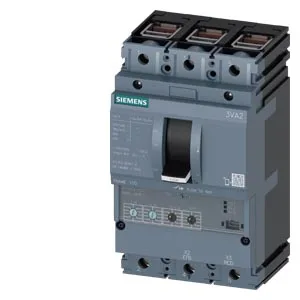
The Siemens SENTRON 3VA2010-6HN36-0HL0 is a 3-pole molded case circuit breaker rated for 100 A continuous current across the full operating temperature range of -25 °C to 70 °C — no derating needed up to that ceiling. Breaking capacity hits 242 kA at 240 V, 187 kA at 415 V, and 121 kA at 500 V, with a steep drop to 3 kA at 690 V. That 242 kA figure at 240 V puts it in the high-interrupting class for industrial main feeders or large sub-distribution where fault currents are serious. The shunt trip (STL) and the auxiliary switch pack — 2 aux + 1 trip alarm + 1 electrical alarm HQ — mean it can be wired into a remote-trip or status-monitoring circuit without an add-on module. Dimensions are 105 mm wide, 181 mm high, 86 mm deep — standard 3-pole MCCB footprint for a 100 A frame.
How the auxiliary switch pack and shunt trip change the wiring
The supplied basic switch is 3VA20106HN360AA0. The auxiliary release is a shunt trip (STL) — that means a separate control voltage (typically 110–240 V AC/DC) energizes the trip coil to remotely open the breaker. The trip alarm switch changes state only when the breaker trips on fault, not on manual open — useful for a separate alarm circuit. The electrical alarm switch HQ is a high-qualified signal for remote indication. Wire the shunt trip to a pushbutton or PLC output; the aux switches can feed status back to a DI card.
Panel fit and thermal management
At 105 mm wide, this breaker fits a standard 3-pole MCCB cutout. Depth is 86 mm — check the back-of-panel clearance for the shunt trip wiring and auxiliary switch terminals. Maximum power loss is 13.5 W at rated current; that's low enough that no forced cooling is needed in a ventilated enclosure, but if you're packing multiple breakers in a small cabinet, sum the losses and check the temperature rise against the 70 °C operating max.