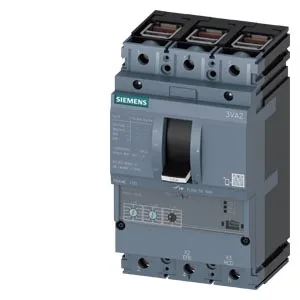
The Siemens SENTRON 3VA2010-7HL36-0AA0 is a 3-pole molded case circuit breaker rated for 100 A continuous current across the full ambient range from 40 °C to 70 °C — no derating needed up to that ceiling. Its interrupting capacity hits 330 kA at 240 V AC, dropping to 242 kA at 415 V and 440 V, then 187 kA at 500 V, and 3 kA at 690 V.
What the interrupting ratings mean for panel design
The 330 kA at 240 V is the headline number, but the real-world selectivity study will use the 242 kA at 415 V or 440 V — that's the common industrial distribution voltage in most markets outside North America. At 500 V the breaker still holds 187 kA, which covers most motor control center bus faults. The 3 kA at 690 V is a steep drop; at that voltage the breaker is essentially a load-break switch with overcurrent protection, not a high-fault device.
Footprint is 105 mm wide, 181 mm tall, 86 mm deep — a standard 3-pole MCCB envelope that fits Siemens SENTRON 3VA mounting bases and busbar adapters. The IP40 front protection means the breaker face is sealed against tools and fingers, but the rear and sides rely on the enclosure for environmental sealing. No undervoltage release, no voltage trip, no communication module onboard; the optional motor drive (noted in the product extension field) can be added for remote tripping or re-closing.