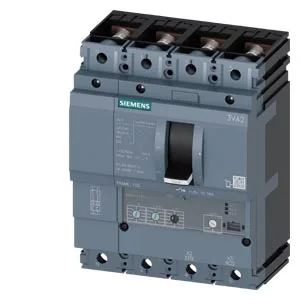
What this MCCB is and what it does
The Siemens 3VA2010-7HL42-0AA0 is a SENTRON molded case circuit breaker (MCCB) rated for 100 A continuous current, built around the ETU320 electronic trip unit. It's a 4-pole device designed for line protection — meaning it sits at the feeder or main distribution point in a panel, not on a specific motor or load branch. The ETU320 gives you adjustable overload and short-circuit protection curves, which is what you want when coordinating downstream breakers or meeting selective coordination requirements on a 480 V or 600 V industrial service.
Breaking capacity — what the numbers mean for your fault duty
This breaker carries a 330 kA interrupting rating at 240 VAC, dropping to 242 kA at 415 V and 440 V, then 187 kA at 500 V, and finally 3 kA at 690 V. The 330 kA at 240 V tells you it's built for high-fault applications like transformer secondaries or large UPS output panels where the available fault current is massive. At 480/277 V systems — common in North American industrial — the 242 kA at 440 V is the closest published figure, and it still gives substantial headroom over a typical 65 kA or 100 kA rated panel. The steep drop to 3 kA at 690 V means this isn't a 690 V main breaker; it's a 240–500 V device with a very high short-circuit rating in that band.
Thermal performance and panel integration
The 100 A continuous rating holds flat from 40 °C all the way to 70 °C ambient — no derating needed in a warm enclosure, which is unusual for an MCCB. That means you can pack it into a panel running hot without recalculating the load schedule. The 7.7 W maximum power loss is the heat it dumps into the enclosure; for a 100 A 4-pole breaker that's modest, so it won't drive extra cooling in most cabinets. Dimensions are 140 mm wide, 181 mm tall, and 86 mm deep — a standard 4-pole MCCB footprint that drops into SENTRON mounting bases without adapters. The front face carries IP40 protection, so it's fine in a clean panel but not washdown-rated.
