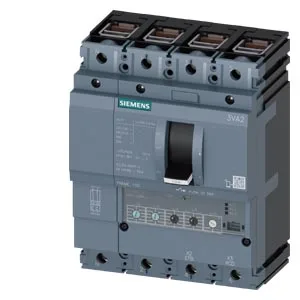
Its interrupting capacity reaches 330 kA at 240 V, stepping down to 242 kA at 415 V and 440 V, and 187 kA at 500 V — at 690 V it holds 3 kA, which tells you this breaker is built for low-voltage main or feeder duty, not 690 V branch circuits.
The 330 kA at 240 V is the headline number, but the real-world decision point for most industrial panels is the 242 kA at 415 V — that covers common 400 V class distribution. The 3 kA at 690 V is a residual rating; this breaker is not your primary choice for 690 V switchgear.
The 140 mm width is the key dimension for multi-pole grouping in a panel — four poles at that width means 35 mm per pole, which is typical for this frame class.
Ground-fault and monitoring capability
This variant includes ground-fault monitoring via summation current formation on L + N conductors — it senses the vector sum of line and neutral current, so it catches leakage to ground without a separate sensor.