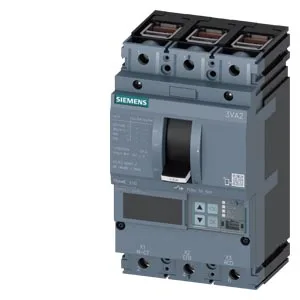
What this MCCB is and what it does
The Siemens 3VA2010-7JQ36-0AA0 is a SENTRON molded case circuit breaker (MCCB) designed for line protection in distribution panels. It is a 3-pole unit rated for 100 A continuous current across the full ambient range from 40 °C to 70 °C — no derating needed up to that ceiling. The interrupting capacity hits 330 kA at 240 V, 242 kA at 415 V and 440 V, and 187 kA at 500 V; at 690 V it drops to 3 kA, so for 690 V applications you need to check coordination with upstream devices. The breaker includes a communication function for integration into a monitored system and has ground-fault monitoring via summation current formation on the L-conductor.
Dimensions and panel fit
The MCCB measures 86 mm deep, 105 mm wide, and 181 mm tall. That 105 mm width across 3 poles is the standard SENTRON 3VA footprint — it fits the same DIN-rail or mounting-plate cutout as other breakers in the family. The 86 mm depth leaves room for rear busbar connections in a typical distribution panel without crowding the gland plate.
Key ratings and what they mean for selection
The 100 A continuous rating is flat from 40 °C to 70 °C ambient — no thermal derating curve to calculate for most panel environments. The interrupting capacity at 240 V (330 kA) is extremely high, suited for installations with very high available fault current, such as near a utility transformer. At 415 V and 440 V the 242 kA rating still covers most industrial service entrances. The maximum power loss is 7.7 W, which is modest for a 100 A frame and keeps heat buildup manageable in a sealed enclosure.
Protection and monitoring features
This breaker is designed for line protection — meaning it protects the cable or busbar, not a motor or other load directly. The ground-fault monitoring uses summation current formation on the L-conductor, which detects leakage by summing the phase currents; it does not require a separate neutral CT. There is no undervoltage release and no voltage-trigger function on this variant, so it is a straightforward thermal-magnetic or electronic trip unit (the spec does not specify the trip technology, but the communication function suggests an electronic trip unit capable of remote monitoring).
Environmental limits
Operating temperature range is -25 °C to 70 °C, with storage from -40 °C to 80 °C. That covers most indoor industrial and commercial environments, including unheated warehouses in cold climates. The -25 °C lower operating limit means it can be installed in a non-conditioned space in most temperate zones.
