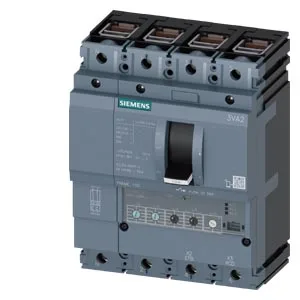
Breaking capacity drops from 440 kA at 240 V to 330 kA at 415 V and 440 V, then to 220 kA at 500 V, and 52.5 kA at 690 V. The 330 kA at 415 V is the figure that governs most European 400 V distribution panels — it's well above typical transformer fault levels (usually 25–50 kA), so this breaker gives substantial selectivity headroom downstream. At 690 V the 52.5 kA still covers most motor-drive branch circuits, but verify against your transformer impedance if feeding a 690 V bus.
Ground-fault monitoring and trip functionality
Ground-fault monitoring uses summation current formation on L + N conductors — it measures vector sum of phase and neutral currents, so it detects leakage to earth without a separate sensor. Trip indicator is absent, and there is no undervoltage release or voltage trigger. The breaker is a straight thermal-magnetic line-protection device with added ground-fault sensing, not a full electronic trip unit. Maximum power loss is 7.7 W at rated load, which matters for ventilation in sealed enclosures.