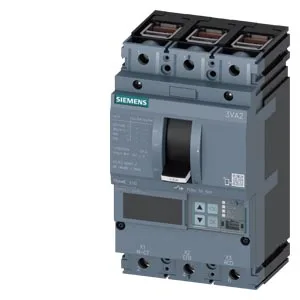
What this MCCB does and where it fits
The Siemens SENTRON 3VA2010-8JQ36-0AA0 is a 3-pole molded case circuit breaker (MCCB) designed for line protection — meaning it sits at the incoming feed of a panel or distribution board to guard against overcurrent and short-circuit faults. Rated for 100 A continuous current with an interrupting capacity of 440 kA at 240 V, it handles high-fault-current scenarios like large transformer secondaries or industrial mains without cascading failure upstream. The frame has a 150 A minimum and 1 200 A maximum current setting range. The 800 V rated insulation voltage provides headroom for higher-voltage systems.
Breaking capacity — what the numbers mean for your fault-current study
Interrupting ratings drop as system voltage rises: 440 kA at 240 V, 330 kA at 415 V and 440 V, 220 kA at 500 V, and 52.5 kA at 690 V. That 690 V figure is the one that matters for 600 V class gear — it still clears 52.5 kA, which covers most industrial service-entrance faults. If your available fault current at the panel exceeds these per-voltage limits, you need a current-limiting upstream device or a higher-rated frame.
Thermal performance — it holds 100 A all the way to 70 °C
Continuous current rating stays at 100 A from 40 °C through 70 °C ambient. Max power loss is 7.7 W. Dimensions are 86 mm deep, 105 mm wide, 181 mm tall (–). That's a standard 3-pole MCCB footprint for a 100 A frame — fits existing SENTRON mounting rails and busbar systems without panel rework.
Ground-fault and communication options
This variant includes ground-fault monitoring via summation current formation on the L-conductor — it detects leakage by summing phase currents, so you don't need a separate GFCI module. Communication function is present, which means it can integrate with a building management or power-monitoring system over the SENTRON communication bus. Operating temperature range is -25 °C to 70 °C; storage range is -40 °C to 80 °C. That covers unheated electrical rooms and outdoor enclosures in most climates.
