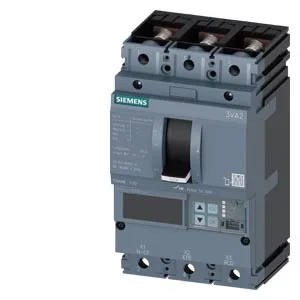
What this MCCB is and where it lands
The Siemens SENTRON 3VA2010-8KQ32-0AA0 is a 3-pole molded case circuit breaker (MCCB) rated for 100 A continuous current across the full ambient range from 40 °C to 70 °C — no derating needed up to the enclosure's thermal limit. It's designed for line protection in distribution panels, meaning it sits at the feeder or subfeeder position, not at a motor branch. The 440 kA breaking capacity at 240 V AC tells you this breaker can interrupt a fault up to that level without upstream fuses or a bigger breaker having to clear first — useful for high-fault utility drops or transformer secondaries. At 415 V and 440 V it still holds 330 kA, dropping to 220 kA at 500 V and 52.5 kA at 690 V. That's a serious SCCR envelope for a 100 A frame.
Breaking capacity — what the numbers mean for your panel
The 440 kA at 240 V is the maximum interrupting rating; it's the peak fault current this breaker can safely clear at that voltage. At 415 V and 440 V the rating drops to 330 kA, and at 500 V to 220 kA. At 690 V it's still 52.5 kA. These are the values you need for a selective coordination study — if the available fault current at the breaker's location exceeds the rating at the system voltage, you need a higher-rated frame or upstream current limiting. The 100 A continuous rating is flat from 40 °C to 70 °C, which is unusual — most MCCBs derate above 40 °C. That means you can run this breaker at full 100 A in a warm enclosure without oversizing the frame.
Dimensions and panel fit
The breaker measures 181 mm high, 105 mm wide, and 86 mm deep. That 86 mm depth is the body depth — it fits standard 200 mm deep enclosures with room for wiring gutters. The 105 mm width is the pole pitch for a 3-pole MCCB; it occupies three 35 mm DIN-rail modules worth of panel width if mounted on a backplate. No special cutout needed beyond the standard MCCB footprint.
What's inside — communication and ground-fault monitoring
This breaker includes a communication function — it can talk to a higher-level system for status and trip data, though the protocol isn't specified in the basic listing. It also has a ground-fault monitoring version configured for summation current formation on the L-conductor. That means it sums the phase currents and looks for imbalance to ground — useful for detecting leakage in ungrounded or high-resistance-grounded systems. No undervoltage release, no voltage trigger, no trip indicator on this variant. The initial value is set at 20 A, with a full-scale of 100 A. Power loss is 7.7 W maximum at rated load.
Environmental range and storage
Operation from -25 °C to 70 °C; storage from -40 °C to 80 °C. The insulation voltage is rated at 800 V, so it's comfortable on 690 V systems with margin. The storage low end matters if the breaker sits in an unheated warehouse before installation — it can handle the cold, but you need to let it warm up before energizing if it's been below -25 °C.
