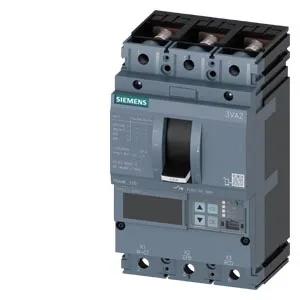
The Siemens 3VA2025-5JQ32-0AA0 is a 3-pole SENTRON molded case circuit breaker (MCCB) rated for 25 A continuous current, with an adjustable thermal-magnetic trip unit covering 38 A minimum to 300 A maximum. That wide trip range lets you dial in the protection for the actual load without swapping the breaker — useful when the panel feeds a motor that draws less than the bus rating. Breaking capacity is the headline here: 187 kA at 240 V AC, 121 kA at 415/440 V, 75.6 kA at 500 V, and 3 kA at 690 V. At 240 V that's enough to sit ahead of a transformer or a high-fault bus without worrying about cascading failure upstream. It carries a communication function onboard, so it can talk to a PLC or BMS for remote trip indication and load monitoring — no separate add-on module required for basic signaling. That saves a DIN slot and a wiring step.
Operating temperature range from -25 °C to 70 °C, with no derating on the 25 A rating across that entire span — the spec sheet shows 25 A at every 5 °C step from 40 °C up to 70 °C. That's unusual; most MCCBs start pulling current back above 40 °C.
What the trip adjustment means in practice
The adjustable trip range of 38 A to 300 A on a 25 A continuous-rated breaker might look odd — it means the thermal-magnetic element can be set to protect a downstream load that draws more than the breaker's own frame rating? No. The 38-300 A range is the magnetic (short-circuit) pickup adjustment. You set the magnetic trip threshold so the breaker clears a fault fast enough to protect the cable, but rides through motor inrush. That's the coordination knob. If you need UVR for a safety circuit, you'd step to a different suffix.