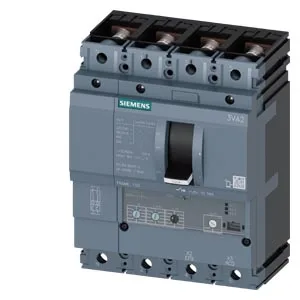
What this MCCB is and where it fits
The Siemens SENTRON 3VA2025-6HL42-0AA0 is a 4-pole molded case circuit breaker (MCCB) rated for 25 A continuous current, built around the ETU320 electronic overcurrent release. It is designed for line protection in distribution panels — the kind of duty that holds a feeder or a motor control center on the grid until a fault is cleared, provided the trip curve is set correctly for the downstream load. Breaking capacity is what earns this breaker its place in high-fault installations: 242 kA at 240 V AC, 187 kA at 415 V and 440 V, 121 kA at 500 V, and 3 kA at 690 V. Those numbers mean it can interrupt a bolted fault at the service entrance without the arc re-striking, provided the available fault current at the panel does not exceed the rated value for the system voltage. The ETU320 release is an electronic trip unit — it gives you adjustable long-time, short-time, and instantaneous protection bands, which is what you want when coordinating with downstream breakers on a selective coordination study. No undervoltage release, no shunt trip, no communication module on this variant; it is a straight line-protection breaker with a fixed 25 A sensor rating.
Physical fit and panel integration
Footprint is 140 mm wide by 181 mm tall by 86 mm deep — a 4-pole frame that occupies roughly the same DIN-rail or mounting-plate real estate as a 160 A frame from the same SENTRON family. The IP40 front rating means it is protected against tools and solid objects larger than 1 mm, but not against water ingress; mount it inside a panel with a sealed gland plate if the environment sees washdown or condensation. Maximum power dissipation is 0.84 W at rated current — negligible for panel heat-budget calculations, but it does mean the breaker runs cool even in a crowded enclosure. The operating temperature range spans -25 °C to 70 °C, with storage from -40 °C to 80 °C, so it handles unheated warehouses and roof-top enclosures provided the ambient stays within those limits.
