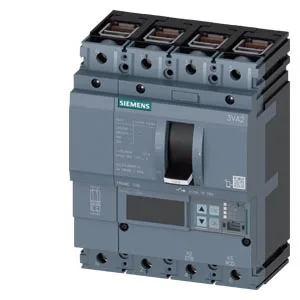
Its 25 A continuous current rating sets the maximum load it carries without tripping — size your downstream conductors and load to stay under that figure. At 415 V and 440 V the interrupting rating drops to 187 kA, at 500 V to 121 kA, and at 690 V to 3 kA — so if your system runs 690 V, verify the available fault current stays under 3 kA or you need a current-limiting upstream device. The ground-fault monitoring version uses summation current formation on L + N conductor, so it detects leakage by comparing phase and neutral current; any imbalance trips the breaker. That's a different animal from a simple thermal-magnetic MCCB — expect a separate ground-fault pickup setting (not listed here) that you'll need to coordinate with downstream GFP devices. The 25 A rating holds across the full operating band (–) — no derating needed up to 70 °C, which is unusual for a molded case breaker and simplifies panel design in hot environments like a motor control center near a furnace line.
Dimensions: 181 mm height, 140 mm width, 86 mm depth. Width of 140 mm is wider than a typical 4-pole MCB, so verify the DIN-rail spacing or bolt-on footprint in your existing panel layout. Communication function is present — this variant supports the SENTRON 3VA communication module for PROFIBUS or PROFINET, enabling remote trip indication, current metering, and parameterization.
Comparison: how this sits against a peer
The closest functional second-source in the evidence is 5SQ2670-2YA63. Both are 4-pole molded case breakers from Siemens' SENTRON family, but the 5SQ series is an older generation with different accessory compatibility.