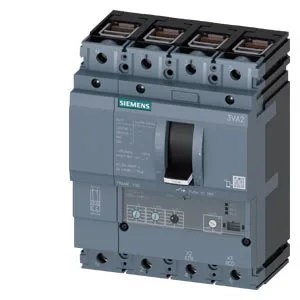
At 240 V it's rated for 187 kA, at 415 V and 440 V it holds at 121 kA, at 500 V it's 75.6 kA, and at 690 V it drops to 3 kA. The 690 V rating is low — this breaker is not your first pick for a 690 V motor feeder unless the fault current is well under 3 kA.
The closest functional peer in the SENTRON family is the 3VA1110-5ED36-0AA0, which is also a 4-pole MCCB with an electronic trip unit. The key difference is frame size and current range. The 3VA2040 is a larger frame (3VA2) with a 40 A continuous rating and an adjustable range that goes up to 480 A. The 3VA1110 is a smaller frame (3VA1) with a lower continuous rating and a narrower adjustment band. If your panel was laid out for a 3VA1110, the 3VA2040 will not drop in without rewiring — the frame dimensions and bus bar connections are different. Stick with the 3VA1110 if your load is under 40 A and you need the smaller footprint; move to the 3VA2040 if you need the higher interrupting capacity or the wider adjustment range for future load growth.
What the ratings mean in the panel
The ETU320 trip unit gives you electronic adjustability: you set the long-time pickup (Ir) anywhere between 60 A and 480 A, plus short-time and instantaneous bands. The lack of a voltage-trigger or undervoltage-release option on this specific variant means it's a straight thermal-magnetic replacement — no shunt-trip or UVR coil to wire. No communication function either, so this is a standalone breaker, not a smart metering device. If you need remote trip indication or power monitoring, you'd look at the 3VA2 variants with the communication option. No ground-fault monitoring version here — if you need GFCI functionality at the breaker, this isn't the variant; you'd need the 'without' designation to be 'with'.