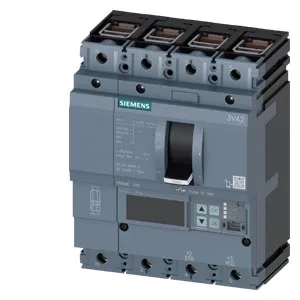
The 4-pole configuration covers three-phase plus neutral, common in North American and IEC distribution where the neutral needs switching or isolation.
This breaker's interrupting capacity varies sharply with system voltage, which is the spec you need to match to your available fault current. At 240 V it's rated 187 kA — plenty for most secondary distribution. At 500 V it drops to 75.6 kA, and at 690 V it's only 3 kA. If your service is 480 V, the 121 kA at 440 V is the closest published figure; the 690 V number tells you this is not a 690 V main breaker.
ETU550 trip unit and communication
The ETU550 is an electronic trip unit — adjustable, with curve shaping and communication capability onboard. That communication function means it can talk to a BMS or PLC for power monitoring and trip event logging, not just passive protection. The trip indicator is not fitted, so you won't get a local mechanical flag; fault events are read through the communication channel or by checking the breaker position. No undervoltage release and no ground-fault monitoring version on this variant. If those functions are required, you'd look at a different suffix in the 3VA2 family.
That width for a 4-pole frame is standard for this class — check your panel's backplate layout and phase-to-phase clearance.