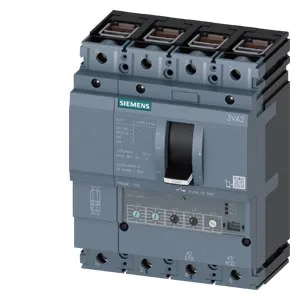
Feeder protection for high-fault panels
It carries a 242 kA interrupting capacity at 240 V, dropping to 187 kA at 415 V and 440 V, and 121 kA at 500 V — numbers that put it in main-feeder territory for industrial switchboards where fault currents run high. The ETU330 trip unit gives you adjustable long-time pickup and delay (I²t response time adjustable from 0.5 to 17 seconds), plus selectable N-conductor protection — OFF or 100% of phase rating. That means you can tune it for feeder coordination without swapping trip packs. That simplifies panel layout in hot enclosures or next to transformers.
Dimensions: 181 mm height, 140 mm width, 86 mm depth — the 86 mm depth is shallow enough for most 200 mm-deep enclosures without forcing a deeper gland plate. IP40 on the front, so it is protected against tool contact but not washdown; keep it behind a panel door. Four-pole design (/L2/L3/N) with a ground-fault monitoring version using summation current formation on L+N. The N-conductor protection can be switched OFF or set to 100%, which matters when you are feeding a delta-wye transformer or a mixed load where the neutral carries less than the phases. Maximum power loss is 2.2 W — negligible for thermal budgeting inside a panel, but worth noting if you are packing 20+ of these in a row.
At 690 V the interrupting capacity drops to 3 kA, so on 690 V systems it is strictly a downstream load-break device, not a main.