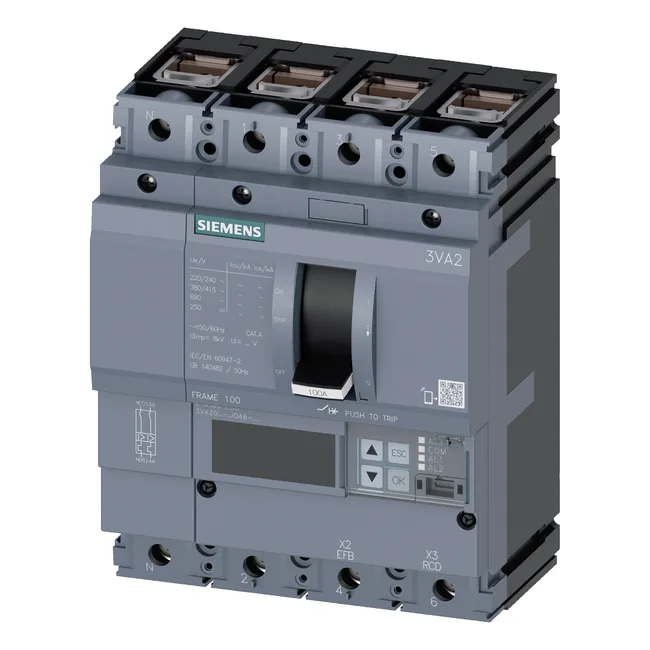
The Siemens SENTRON 3VA2040-6JQ46-0EG0 is a 4-pole molded case circuit breaker (MCCB) rated for 40 A continuous current (Iu) at 40 °C, with an ETU560 electronic trip unit that provides adjustable overload and short-circuit protection for line-feeder and distribution applications. The front-face IP40 rating suits it for enclosed panel mounting where tools or fingers won't contact live parts.
The 40 A rating holds flat from 40 °C through 50 °C, then derates to 38.5 A at 55 °C, 37 A at 60 °C, 35.5 A at 65 °C, and 34 A at 70 °C. For a panel running at 55 °C ambient, the breaker still carries 38.5 A — enough for a 40 A feeder if the load stays under that. Breaking capacity drops from 242 kA at 240 V to 187 kA at 415 V and 3 kA at 690 V; on a 400 V supply the 187 kA figure governs the SCCR coordination study.
Integration notes
Dimensions are 181 mm high × 140 mm wide × 107 mm deep — a standard 4-pole MCCB footprint for a 160 A frame. The ETU560 release supports communication, so it can report trip events and load data over the SENTRON bus system. The undervoltage release is a UVR(LNO) design with leading NO contacts, which means it drops the breaker on loss of control voltage and signals the open state through the NO contact before the main contacts part. Ground-fault detection uses summation current on L+N conductors.