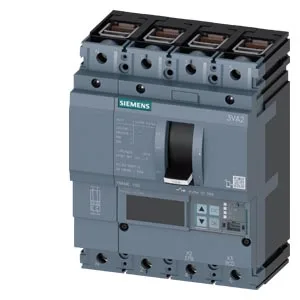
At 415 V and 440 V it still holds 187 kA, dropping to 121 kA at 500 V and 3 kA at 690 V, so the voltage class of your supply determines the fault-clearing headroom you actually get. The 2.2 W maximum power loss is low enough that ventilation spacing in a standard enclosure is adequate — no forced cooling required for this breaker alone. A communication function is built in, so this unit can report status or trip events over a bus without an add-on module — useful for a maintenance team that wants to know which breaker opened before walking the panel.
Dimensions are 181 mm height, 140 mm width, 86 mm depth — a standard 4-pole MCCB footprint that fits Siemens SENTRON mounting plates and most DIN-rail adapter kits. The breaker accepts a continuous current range from 60 A minimum to 480 A maximum via interchangeable trip units, but this specific variant is factory-set at 40 A. If your load draw is higher, you would select a different 3VA2 order code with the appropriate rating plug.
Ground-fault monitoring uses summation current formation on L+N conductors, meaning it detects imbalance between phase and neutral — standard for solidly-grounded systems. No undervoltage release or voltage trip is fitted on this variant.