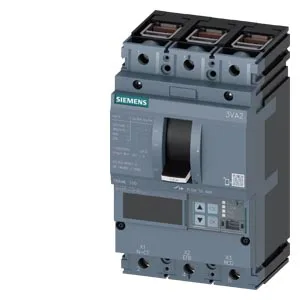
It's a line-protection device — meaning its job is to sit in a distribution panel and clear faults on feeder or branch circuits before the damage cascades upstream.
That's unusual for an MCCB and simplifies panel design: you can load it to 40 A even at 70 °C ambient. Interrupting capacity drops as system voltage climbs: 330 kA at 240 V, 242 kA at 415 V and 440 V, 187 kA at 500 V, and 3 kA at 690 V. For a 480 V panel, the 187 kA figure still covers most industrial service-entrance fault levels. The ETU550 is a communicating electronic trip unit — it supports the communication function listed on the nameplate, which means it can talk to a higher-level monitoring system for load profiling and event logging. The 1.2 W maximum power loss is negligible for thermal budgeting inside a cabinet.