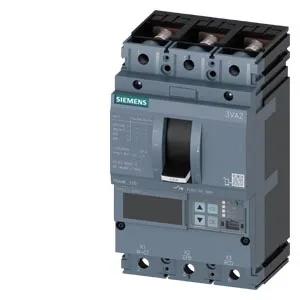
What this MCCB delivers in a panel
The Siemens 3VA2040-8JQ32-0AA0 is a SENTRON molded case circuit breaker rated for line protection, carrying a continuous current of 40 A across the full ambient range from 40 °C up to 70 °C — no derating needed in a warm enclosure. It is a current-production part (lifecycle stage: current), so you are specifying a breaker Siemens plans to support. The 3-pole design handles three-phase loads, and the ETU560 electronic trip unit gives you adjustable time-current curves (tr from 0.5 to 25, tsd up to 0.5 s) for selectivity downstream. With a breaking capacity of 440 kA at 240 V and still 53 kA at 690 V, it clears high-fault conditions without upstream coordination headaches. The 86 mm depth and 105 mm width fit standard switchboard mounting; the IP40 front protection keeps dust out of the enclosure face.
Breaking capacity and what it means for your fault duty
This MCCB's interrupting rating is specified at multiple system voltages: 440 kA at 240 V, 330 kA at both 415 V and 440 V, 220 kA at 500 V, and 53 kA at 690 V. That means it can safely interrupt a fault up to those levels without exploding or welding contacts — critical for high-available-fault-current installations like transformer secondaries or large motor control centers. The 53 kA at 690 V is still well above typical industrial SCCR requirements; you are not bumping into limits even on 690 V mining or marine supplies.
Thermal performance and enclosure planning
Rated continuous current holds at 40 A from 40 °C through 70 °C ambient — no thermal derating curve to worry about when you pack breakers into a hot panel. Power loss is only 1.2 W maximum, so heat buildup inside the enclosure is minimal. The storage range of -40 °C to 80 °C and operating range of -40 °C to 70 °C mean it survives cold warehouses and hot switchrooms alike. Latching endurance is rated at 20 000 cycles, which covers frequent switching in process lines.
Communication and monitoring capability
The breaker includes a communication function (yes) and a ground-fault monitoring version that uses summation current formation on the L-conductor. That means you can integrate it into a higher-level monitoring system — useful for predictive maintenance or remote trip indication. The ETU560 release allows adjustable response times for both long-time (tr) and short-time (tsd) protection, giving you selectivity coordination with downstream breakers.
