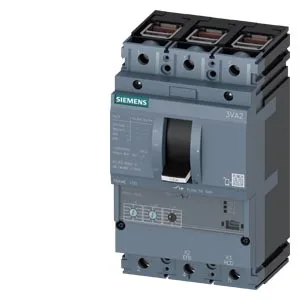
What this MCCB is and what it protects
The Siemens SENTRON 3VA2063-5HL36-0HH0 is a 3-pole molded case circuit breaker (MCCB) rated for 63 A continuous current, designed specifically for line protection in distribution panels and switchgear assemblies. This is the breaker you spec when you need a fixed thermal-magnetic trip that holds its rating flat across the full ambient temperature range from -25 °C to 70 °C — no derating up to 70 °C, which simplifies panel design in warm enclosures (, –).
Breaking capacity that decides the fault duty
Breaking capacity is the number that determines whether this breaker clears a fault without welding contacts or venting arc gas into the panel. At 240 V it interrupts 187 kA; at 415 V and 440 V it still holds 121 kA; at 500 V it drops to 75.6 kA; and at 690 V it is rated 3 kA. For a 480 V distribution panel (common in North American industrial plants) the 75.6 kA at 500 V gives you headroom above the typical 65 kA SCCR requirement — useful when the transformer is oversized or the utility fault current is high.
Built-in auxiliary switch and shunt trip
This variant ships with 2 auxiliary switches plus 1 trip alarm switch (HQ type), and a shunt trip (STL) auxiliary release factory-installed. That means you get remote status indication (open/closed/tripped) and a remote-trip input without adding external relays or drilling the cover for aftermarket accessories. The shunt trip is useful for emergency-off circuits or interlocking with a downstream VFD or PLC safety output.
Physical fit and panel integration
Dimensions are 105 mm wide, 181 mm high, 86 mm deep. That 105 mm width is the standard 3-pole MCCB footprint for Siemens SENTRON 3VA2 frame — it clips onto a DIN rail or mounts directly to a backplate. The depth of 86 mm means it clears a 100 mm deep enclosure with room for wiring behind the breaker.
Power loss and thermal management
Maximum power loss is 5.4 W. In a multi-breaker panel, that is low enough that you do not need forced ventilation for thermal management — natural convection through the enclosure vents handles it, provided the ambient stays under 70 °C.
