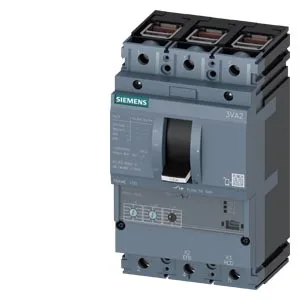
Its headline breaking capacity is 187 kA at 240 V, dropping to 121 kA at 415 V and 440 V, then 79 kA at 500 V, and 3.4 kA at 690 V — that 187 kA figure means it can safely interrupt a bolted fault at the main distribution board without upstream cascading, which is what you need for a transformer-fed 240 V service entrance or a high-fault industrial panel. The 63 A rating holds flat from 40 °C through 50 °C; above that it derates linearly to 53.55 A at 70 °C, so if your enclosure runs hot, size the load accordingly. The ETU320 release is an electronic, non-communicating trip unit — no Modbus, no PROFIBUS, no IO-Link. It provides LI (long-time) and SI (short-time) protection curves plus instantaneous pickup. If you need zone-selective interlocking or energy monitoring, you step up to an ETU6xx or ETU8xx variant. The shunt trip (STL) integrated here allows a remote pushbutton, PLC output, or emergency-stop circuit to open the breaker independently of the trip unit.
The auxiliary contact block (2 aux + 1 trip alarm + 1 electrical alarm) is pre-assembled; no additional side-mounting kit needed for basic signaling. The shunt trip (STL) is factory-integrated, so no field wiring of a separate undervoltage or shunt release module.
As a SENTRON MCCB, this unit carries IEC 60947-2 certification for industrial application. The ETU320 release is UL 489 listed for the North American market. RoHS and REACH compliance documentation is available from Siemens upon request. The rated insulation voltage (Ui) is 800 V, and the operating temperature range is -25 °C to +70 °C, with storage from -40 °C to +80 °C. Maximum power loss is 5.4 W at rated current.