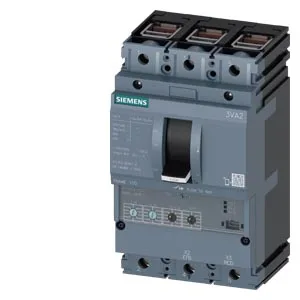
It's rated for 63 A continuous current (Iu) across the ambient range from 40 °C to 50 °C, with a slight derate as you climb past 55 °C — at 70 °C it still carries 53.55 A, so it handles warm enclosures without a drama. The interrupting capacity is the headline here: 187 kA at 240 V, 121 kA at 415 V and 440 V, 79 kA at 500 V, and 3.4 kA at 690 V. That kind of headroom means it'll clear a bolted fault upstream of a motor starter or a feeder without the arc flash energy getting out of hand — you can coordinate selectivity downstream without worrying about the main breaker letting go first. It carries an ETU350 electronic trip unit — that's the adjustable thermal-magnetic replacement that gives you long-time, short-time, and instantaneous pickup settings. The auxiliary contacts are two built-in switches (HQ type), so you get status feedback without an add-on block.
The 105 mm width means it takes three 18 mm pole spaces on the DIN rail, same footprint as the rest of the 3VA2 family. The terminals accept the usual lug sizes for 63 A; no special busbar adapters needed for the SENTRON range.
For a 63 A feeder, that's way above typical utility fault currents (usually 10–25 kA at the service entrance), so you've got selectivity headroom to let downstream breakers trip first.