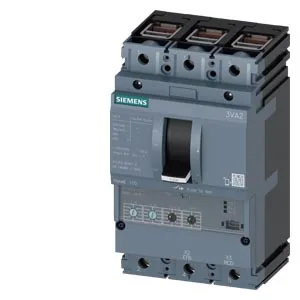
63 A MCCB with full-rated interrupting capacity across the voltage range
The Siemens SENTRON 3VA2063-5HN36-0CH0 is a 3-pole molded case circuit breaker rated for 63 A continuous current with no derating across the full operating temperature band of -25 °C to 70 °C — the breaker delivers its full 63 A at every point in that range, not just at 40 °C. Interrupting capacity is 187 kA at 240 V, 121 kA at 415/440 V, 75.6 kA at 500 V, and 3 kA at 690 V, per the datasheet figures. That 187 kA at 240 V is the headline number for high-fault industrial services; the 121 kA at 415 V covers the common European low-voltage distribution level. The unit ships with an undervoltage release (UVR) and a factory-fitted auxiliary switch block comprising 2 auxiliary switches plus 1 trip alarm switch (HQ type).
Panel footprint and mounting
Dimensions are 105 mm wide × 181 mm high × 86 mm deep. The 86 mm depth is the dimension that governs projection into the enclosure — relevant when fitting behind a gland plate or alongside busbar trunking. The 105 mm width matches the standard SENTRON 3VA2 three-pole form factor, so it occupies one 105 mm module on a DIN rail or mounting plate. The breaker is designed for line protection (cable and busbar feeder duty) per the product designation.
Auxiliary release and switch complement
The breaker includes an undervoltage release (UVR) as the auxiliary release — this trips the breaker when supply voltage drops below a threshold, used for under-voltage protection or emergency stop circuits. The auxiliary switch configuration is 2 auxiliary switches plus 1 trip alarm switch (HQ). The trip alarm switch changes state only when the breaker trips on fault, providing a separate signal for remote fault indication. The basic switch assembly is order code 3VA20635HN360AA0.
Thermal and power dissipation
Maximum power loss is 7.9 W at rated current. Storage temperature range is -40 °C to 80 °C, which exceeds the operating range — relevant for warehousing or seasonal shutdown. The trip indicator is present, giving local mechanical indication of trip state without needing to open the door.
