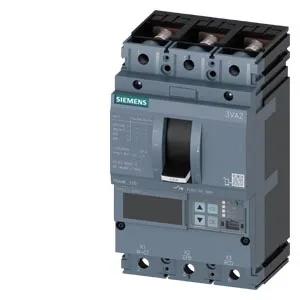
Three-pole construction, so it switches all phases simultaneously. The breaking capacity climbs to 187 kA at 240 V AC, drops to 121 kA at 415 V and 440 V, then 75.6 kA at 500 V, and 3 kA at 690 V. That 187 kA figure at 240 V means it can interrupt a fault current up to 187,000 amps on a 240 V line without failing — critical for high-fault installations like large transformer secondaries or industrial mains. That UVR is useful for preventing automatic restart after a brownout or for coordinated undervoltage protection in a motor control center. That means it measures the vector sum of phase currents to detect leakage to ground — a common requirement for personnel protection or equipment protection in grounded systems.
That 105 mm width is the standard 3-pole MCCB footprint for the SENTRON 3VA2 frame — it occupies three 35 mm DIN module positions (at roughly 35 mm per pole) plus a small margin. The communication function suggests it can integrate with a bus system for remote monitoring or trip indication — check the specific protocol (PROFIBUS, PROFINET, or Modbus) against your control network before ordering.
What compliance documentation comes with it
As a Siemens SENTRON product, this MCCB carries CE marking for the European market and is designed to meet IEC 60947-2 for molded case circuit breakers. UL and CSA listings are typical for the 3VA2 series, but verify the specific UL file number against your local code requirement — some variants carry UL 489, others UL 1066 depending on the rating. RoHS and REACH declarations are available from Siemens on request.