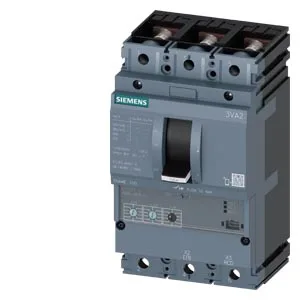
63 A SENTRON MCCB with shunt trip — line protection variant
The Siemens 3VA2063-6HL32-0JA0 is a SENTRON molded case circuit breaker (MCCB) rated for 63 A continuous current (Iu) across a 3-pole configuration, carrying the ETU320 electronic overcurrent release and an integrated shunt trip (STL) auxiliary release. This is the line protection version — no undervoltage release, no ground-fault monitoring, no communication module. The shunt trip (order code 3VA9688-0BL32 for the integrated auxiliary trip) allows remote tripping via a control voltage, which is the main reason a buyer lands on this variant over a plain thermal-magnetic MCCB. Rated insulation voltage Ui is 800 V, and the interrupting capacity varies sharply with system voltage: 242 kA at 240 V, 187 kA at 415 V and 440 V, 121 kA at 500 V, and 4 kA at 690 V. That 242 kA figure at 240 V is the headline — this breaker handles very high fault currents on low-voltage distribution, typical for transformer-secondaries or large busway feeds. At 690 V the capacity drops to 4 kA, so confirm the available fault current if deploying on a 690 V line.
Thermal derating and panel fit
The breaker holds its full 63 A rating up to 50 °C ambient. Above that it derates linearly: 60.6375 A at 55 °C, 58.275 A at 60 °C, 55.9125 A at 65 °C, and 53.55 A at 70 °C. Maximum operating temperature is 70 °C; storage range is -40 °C to 80 °C. Power loss at rated current is 5.4 W — modest for a 63 A frame, but in a densely packed panel with multiple breakers side-by-side, the cumulative heat matters. Mounting dimensions: 105 mm wide, 181 mm high, 86 mm deep. That 105 mm width is a standard 3-pole MCCB footprint for the SENTRON 3VA2 frame; it clips onto a DIN rail or mounts via the rear screw terminals.
What the ETU320 release means for coordination
The ETU320 is an electronic trip unit with fixed (non-adjustable) thermal and magnetic settings, designed for line protection — not motor protection. It provides a fixed time-current curve; there is no LSI adjustment, no ground-fault element, and no communication. For selective coordination studies, the ETU320's fixed curve is simpler to model than an adjustable ETU600, but it also means you cannot fine-tune the long-time pickup or short-time delay. If the application requires adjustable trip settings or zone-selective interlocking, the 3VA2 frame supports ETU330/ETU600 releases on other order codes — but this specific variant is fixed.
