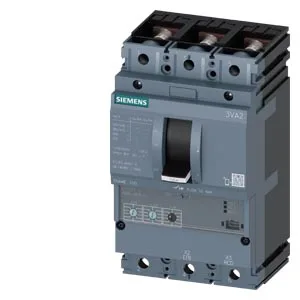
Its 63 A rated continuous current (Iu) holds steady from 40 °C up to 50 °C without derating — at 55 °C it still carries 60.6 A, and you only lose about 10 A by the time the ambient hits 70 °C, so it's a solid choice for a hot enclosure next to a motor or in a sun-baked switchroom. The interrupting capacity is what sets this breaker apart: 242 kA at 240 V, 187 kA at 415 V and 440 V, 121 kA at 500 V, and 4 kA at 690 V. Those numbers mean it can clear a dead short on a 240 V service with over a quarter-million amps of fault current behind it — that's the kind of headroom you need downstream of a large transformer or in a high-fault industrial plant where a smaller MCCB would weld closed. The ETU320 overcurrent release handles the trip curve — it's an electronic trip unit with adjustable settings for long-time, short-time, and instantaneous protection, plus ground-fault capability if you add the module.
Sourcing and lifecycle — still in current production
This part carries a current lifecycle status, meaning Siemens is still building it — no EOL notice, no last-time-buy window to worry about.
The 2 auxiliary switches (HQ type) are integrated at the factory, so you don't have to add a side-mount module in the field.
Comparison with a lower-current sibling
The closest peer in the same SENTRON family is the 3VA1010-2ED32-0JA0 — a 3-pole 100 A frame, but with a lower interrupting capacity and a different trip unit. The 3VA2063-6HL32-0JC0 gives you the 63 A rating with the high-interrupt 3VA2 frame (242 kA at 240 V), while the 3VA1010 frame tops out at a lower SCCR. If your panel was kitted around the 3VA1010, the 3VA2063 is physically larger (105 mm vs 76 mm wide) and won't drop into the same mounting footprint without a backplate change.