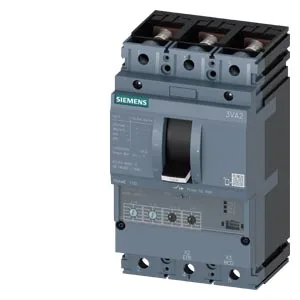
The Siemens 3VA2063-6HN32-0DH0 is a SENTRON 3VA2 molded case circuit breaker (MCCB) rated for 63 A continuous current at 40 °C, with a breaking capacity of 242 kA at 240 V — that's the headline number for high-fault panels where upstream coordination matters. The integrated undervoltage release (UVR) means the breaker drops on loss of control voltage — common in safety circuits or remote E-stop strings. Three poles, line protection version, no ground-fault module on this variant. Physical fit: 105 mm wide, 181 mm tall, 86 mm deep — standard 3-pole MCCB footprint for a 63 A frame. Power loss maxes at 7.9 W, which matters for thermal rise inside a sealed enclosure.
Breaking capacity across voltages — selectivity planning
This breaker's interrupting rating drops as voltage rises: 242 kA at 240 V, 187 kA at 415 V and 440 V, 121 kA at 500 V, and 4 kA at 690 V.
The undervoltage release (UVR) is factory-installed — verify the control voltage matches your system before wiring. The auxiliary contact block (2 NO/NC + 1 alarm) is pre-populated; no separate purchase needed for basic status feedback. The ETU350 trip unit is adjustable via rotary dials on the front face — set the long-time pickup (Ir), short-time pickup (Sd), and instantaneous (Ii) per your coordination study before closing the panel. Derate the continuous current above 55 °C: at 70 °C it's 53.55 A, not 63 A.