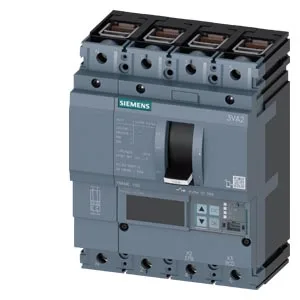
The 3VA2063-6KQ46-0AA0: The interrupting ratings span a wide voltage range: 242 kA at 240 V, 187 kA at both 415 V and 440 V, 121 kA at 500 V, and 3 kA at 690 V. The minimum trip setting is 95 A, and the maximum is 756 A, which gives you a broad adjustment band for coordinating with downstream branch breakers.
Thermal performance and panel fit
Power loss is 5.4 W maximum, which is manageable for enclosure heat calculations.
Communication and monitoring features
This variant includes a communication function, which means it can report status and trip events to a higher-level control system — useful for remote monitoring in a plant SCADA setup. It also has a ground-fault monitoring version using summation current formation on L + N conductors, so it can detect leakage to ground without a separate GFCI module. The trip indicator is not present on this version, and there's no undervoltage release or voltage trigger built in.