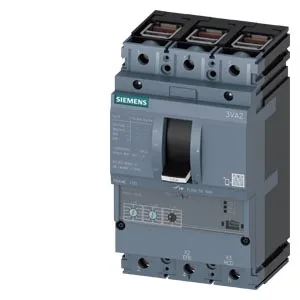
Breaking capacity is a key fit criterion: the 3VA2063-7HL36-0KB0 interrupts 330 kA at 240 V, 242 kA at 415 V, and 3 kA at 690 V. The 415 V figure is the one most often checked for 400 V-class distribution panels — 242 kA covers most industrial main-breaker positions. At 690 V the 3 kA rating limits it to lower-fault applications, but that is typical for a 63 A frame. Thermal derating is mild: the breaker carries 63 A continuously from 40 °C through 50 °C, then drops to 60.6375 A at 55 °C, 58.275 A at 60 °C, 55.9125 A at 65 °C, and 53.55 A at 70 °C. In a warm panel (55 °C internal ambient) you lose about 2.4 A; plan the load margin accordingly.
Auxiliary and trip options
The shunt trip is wired to a remote pushbutton or safety relay for fast disconnection. If you need undervoltage protection or ground-fault sensing, you would step up to a different 3VA2 option code.
The breaker is rated for 20,000 mechanical operations (endurance). Maximum power dissipation is 6 W, which is manageable for thermal calculations in a crowded enclosure.