What it is and what it does
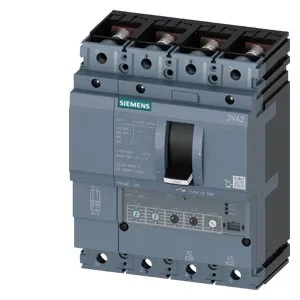
The Siemens 3VA2063-7HM42-0AA0 is a SENTRON molded case circuit breaker (MCCB) designed for line protection — the primary overcurrent device between the transformer or feeder and the distribution bus. It carries a continuous rated current of 63 A across the full ambient range from 40 °C to 70 °C, meaning no derating is needed even in a warm enclosure. Four poles give it the ability to switch all three phases plus the neutral, which is standard for TN or TT systems where the neutral needs to be isolated. The interrupting ratings are the headline: 330 kA at 240 V, 242 kA at 415 V and 440 V, 187 kA at 500 V, and 3 kA at 690 V. That 330 kA figure at 240 V tells you this breaker is sized for high-fault-current locations — think close to a large transformer or a substation tap where available fault current is well above what a standard 65 kA or 100 kA MCCB could handle. The insulation voltage is rated 800 V, so the breaker is electrically suitable for 690 V line-to-line systems with margin. Ground-fault monitoring is built in via summation current formation on the L + N conductors, which means it can detect leakage without needing an external GFCI module — useful on distribution panels feeding sensitive loads or wet-area circuits.
Panel fit and dimensions
The 3VA2063-7HM42-0AA0 measures 181 mm high, 140 mm wide, and 86 mm deep. That 140 mm width for a 4-pole MCCB is standard for the SENTRON 3VA frame — it occupies the same footprint as other 63 A 4-pole units in the series, so a panel laid out for a 3VA2063-8JQ42-0AA0 will accept this breaker without re-drilling the mounting plate or re-routing the bus bars. Operating temperature range is -25 °C to 70 °C, with storage from -40 °C to 80 °C. The maximum power loss is 3 W — negligible for thermal budgeting inside a sealed enclosure, but worth noting if you're packing multiple breakers into a small gland plate area.
