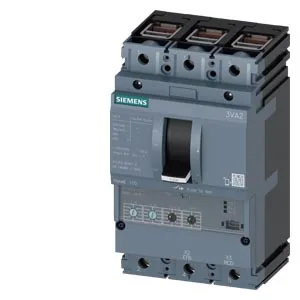
The 3VA2063-7HN36-0AA0: This MCCB delivers 330 kA at 240 V, 242 kA at 415 V, 242 kA at 440 V, 187 kA at 500 V, and 3 kA at 690 V. At 480 V the curve sits between the 440 V and 500 V entries; expect roughly 200 kA symmetrical. The drop to 3 kA at 690 V confirms this is a 600 V-class frame, not a 690 V-rated device for sustained use at that voltage.
Trip unit and protection
The overcurrent release is an ETU350 — an electronic trip unit with adjustable long-time, short-time, instantaneous, and ground-fault protection (though this variant ships without ground-fault monitoring). The ETU350 is the mid-range electronic option in the 3VA family, offering better selectivity than thermal-magnetic releases for feeder coordination studies. Power loss is 3 W maximum, negligible for panel thermal budgeting.
Dimensions are 181 mm high, 105 mm wide, 86 mm deep — a standard 3-pole MCCB footprint for Siemens 3VA frames. The 86 mm depth (3.39 in) leaves clearance for standard gland plates and dead-front covers.