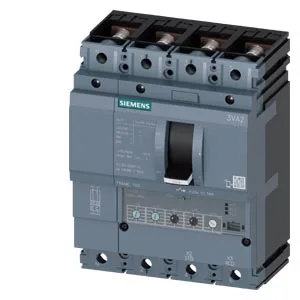
That's a solid spec for a main in a control cabinet that sees summer heat. The interrupting ratings tell you where this breaker can clear a fault without welding or rupturing: 440 kA at 240 V, 330 kA at 415 V and 440 V, 220 kA at 500 V, and 52.5 kA at 690 V. The 4-pole construction handles three-phase plus neutral switching, which is standard for North American and some European distribution schemes.
ETU350 trip unit — what it controls
It's the mid-range electronic trip in the 3VA family — not the basic thermal-magnetic, not the full communications-enabled ETU600. You set the pickup and delay via rotary dials on the front face; no software or handheld programmer needed. The 63 A frame rating is the maximum continuous current this breaker can carry, so the trip unit's sensor is sized for that.
The IP40 front protection means it's sealed against tools and wires larger than 1 mm from the front, but the rear terminals are open to the cabinet. Plan for finger-duct clearance above and below for the line and load lugs.