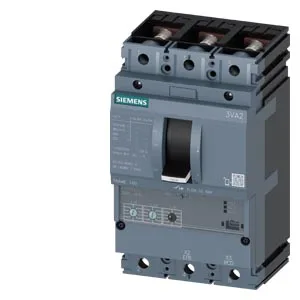
The interrupting capacity is the headline here — 187 kA at 240 V, 121 kA at 415 V and 440 V, stepping down to 79 kA at 500 V and 4.25 kA at 690 V.
The thermal derating curve — where the 100 A holds and where it doesn't
At 55 °C it drops to 96.25 A, then 92.5 A at 60 °C, 88.75 A at 65 °C, and 85 A at 70 °C. If you're packing this breaker into a hot enclosure — say next to drives or transformers — that 70 °C derating to 85 A is the number you need for your load calculation, not the 100 A nameplate. Power loss maxes out at 10 W, which is modest for a 100 A frame and won't cook adjacent components in a well-ventilated panel.
It carries a voltage trigger and a trip indicator, so you get visual confirmation of a trip event without opening the door.
Auxiliary and shunt trip hardware
The integrated auxiliary trip is a shunt trip (STL) that ships as a separate order code: 3VA9688-0BL30. The supplied basic switch is 3VA2110-5HL32-0AA0. If you're replacing an existing 3VA2 breaker and need the same aux contact arrangement, verify the existing wiring matches the HQ configuration before pulling the old one out. For a line-protection breaker that sees infrequent switching (maybe a handful of operations a year), that's more than adequate. If you're using it as a switch-disconnector with daily cycling, you'll want a higher-endurance frame.