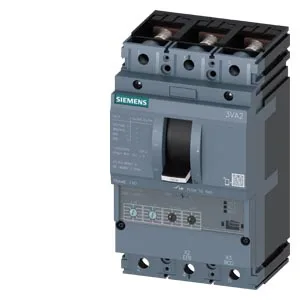
Siemens SENTRON 3VA2110-5HN32-0HH0 — 100 A MCCB with ETU350 Release
The Siemens 3VA2110-5HN32-0HH0 is a SENTRON molded case circuit breaker (MCCB) configured for line protection, rated at 100 A continuous current (Iu) with a 3-pole design. It carries a 187 kA interrupting capacity at 240 V, dropping to 121 kA at 415/440 V, then to 79 kA at 500 V, and 4.25 kA at 690 V — giving you clear SCCR headroom for most industrial distribution panels without needing a current-limiting upstream device. The ETU350 electronic trip unit provides adjustable overload and short-circuit protection curves. The breaker includes a shunt trip (STL) release for remote opening, plus 2 auxiliary switches and 1 trip alarm switch (HQ configuration) for status feedback to a PLC or SCADA. Panel dimensions: 105 mm wide, 181 mm tall, 86 mm deep — fits standard SENTRON 3VA mounting footprint. Rated insulation voltage is 800 V, so it's comfortable on 480/600 V systems with margin.
Thermal Derating and Operating Limits
Rated 100 A from 40 °C through 50 °C ambient. Above 55 °C the breaker derates linearly: 96.25 A at 55 °C, 92.5 A at 60 °C, 88.75 A at 65 °C, and 85 A at 70 °C. If your panel runs hot — say near a VFD bank or inside a sealed enclosure — factor that 85 A floor at 70 °C. Operating temperature range is -25 °C to +70 °C; storage range is -40 °C to +80 °C. Maximum power loss is 10 W at rated current — negligible for panel thermal budgeting.
Lifecycle and Sourcing
The basic switch assembly is order code 3VA2110-5HN32-0AA0; the integrated auxiliary trip is 3VA9688-0BL30. Both are serviceable spares if you need to replace just the trip unit or switch mechanism without swapping the whole breaker.
Selectivity and Coordination Notes
For a 100 A line-protection MCCB with an ETU350, typical selectivity with downstream 20–63 A MCBs holds through most bolted-fault scenarios up to the 50 kA range at 415 V — the electronic trip's i²t-on delay lets downstream devices clear first. If you're coordinating with a 1600 A main breaker upstream, the 121 kA at 415 V gives you full selectivity across the transformer secondary. No undervoltage release, no phase-failure detection, and no communication function on this variant — it's a straightforward line-protection breaker with shunt trip. For a communicating breaker with power metering, look at the 3VA2 with COM module.
