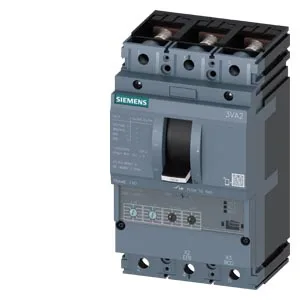
The Siemens 3VA2110-5HN32-0JH0 is a SENTRON molded case circuit breaker (MCCB) rated for 100 A continuous current across the full ambient range from 40 °C to 70 °C — no derating needed up to that ceiling. It is a 3-pole, line-protection design with a shunt trip (STL) release and an auxiliary switch block carrying 2 auxiliary switches plus 1 trip alarm switch (HQ). The interrupting capacity is the headline: 187 kA at 240 V, 121 kA at 415 V and 440 V, 75.6 kA at 500 V, and 3.7 kA at 690 V.
Panel fit and physical integration
Dimensions are 105 mm wide by 181 mm tall by 86 mm deep.
The 100 A rating is flat across the ambient range — no thermal derating curve to calculate. That simplifies panel design: if your load is 100 A or less and the ambient stays under 70 °C, this breaker holds. The 187 kA at 240 V is the SCCR (short-circuit current rating) at that voltage; it means the breaker can safely interrupt a fault up to 187 kA without catastrophic failure. At 690 V the rating drops to 3.7 kA, so if your system runs 690 V with high fault current, this is not the right breaker. Power loss is 10 W maximum — relevant for thermal management in a sealed enclosure.