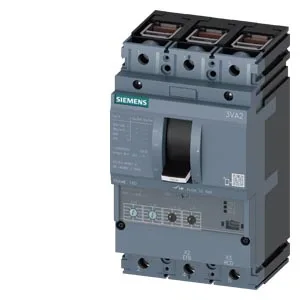
The Siemens SENTRON 3VA2110-5HN36-0BC0 is a 3-pole molded case circuit breaker rated for line protection, carrying a continuous current Iu of 100 A at 40 °C through 50 °C. Above 50 °C the thermal derating curve steps down: 96.25 A at 55 °C, 92.5 A at 60 °C, 88.75 A at 65 °C, and 85 A at 70 °C. Breaking capacity is the real differentiator here. At 240 V it interrupts 187 kA; at 415 V and 440 V, 121 kA; at 500 V, 79 kA; and at 690 V, 4.25 kA. For a 480 V panel in North America, the relevant figure is the 415 V / 440 V rating — 121 kA — which covers most high-fault industrial services. At 690 V the capacity drops sharply to 4.25 kA, so this breaker is not a fit for 690 V systems with fault currents above that level. The overcurrent release is an ETU350 electronic trip unit, adjustable for long-time, short-time, and instantaneous protection. An undervoltage release (UVR) is integrated, and the auxiliary contact version carries 2 auxiliary switches HQ. There is no trip indicator, no voltage trigger, no communication function, no phase failure detection, and no ground fault monitoring — this is a straightforward line-protection breaker with basic auxiliaries.
Panel fit and mechanical endurance
The 20 000 mechanical endurance cycles (latching endurance) is typical for this class; expect the electrical endurance to be lower at full rated current. The maximum power loss of 12.5 W should be factored into the enclosure thermal budget, especially if multiple breakers are ganged.