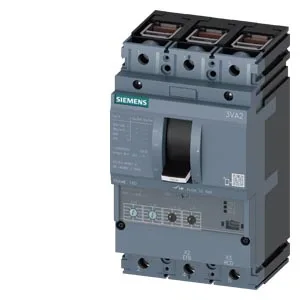
The Siemens SENTRON 3VA2110-5HN36-0BL0 is a 3-pole molded case circuit breaker rated for 100 A continuous current at 40 °C through 70 °C — no derating needed across that band, which simplifies panel design in warm cabinets. Its interrupting capacity hits 187 kA at 240 V AC and still holds 121 kA at 415 V and 440 V, so it handles high-fault utility feeds or transformer secondaries without cascading upstream.
Panel footprint and integration
The 3VA2 frame accepts plug-in or fixed mounting; the supplied basic switch (order code 3VA21105HN360AA0) is the interrupting module, so replacement swaps stay quick. Spring-cage terminals on the line and load side accept copper conductors up to the breaker's rated ampacity. No communication function onboard — this is a standalone thermal-magnetic trip unit, not a networked power breaker.
Breaking capacity selectivity — a real-world read
The 187 kA at 240 V is the headline number, but the more useful figure for 400 V-class panels is 121 kA at 415 V and 440 V — that's the fault level you'll see on a transformer secondary in most industrial installations. At 500 V it drops to 75.6 kA, and at 690 V it falls to 3.7 kA, so this breaker is not suited for 690 V high-fault applications. For a 400 V distribution board with a 100 A feeder, the 121 kA SCCR gives solid selectivity headroom against downstream 18 kA or 25 kA MCBs.
What's in the box — auxiliary and release configuration
The undervoltage release (UVR) is also pre-installed — no field assembly required. Trip indicator is present (mechanical flag visible on the front face). No ground-fault monitoring version, no voltage trigger, no other measurement function. Power loss at full rated current is 12.5 W maximum — negligible for panel thermal budgeting.