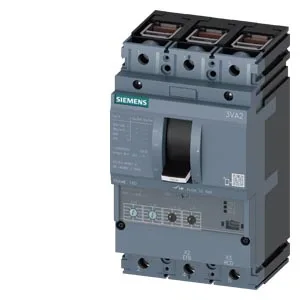
The integrated shunt trip (STL) auxiliary release lets you remotely open the breaker — useful for emergency-off circuits or interlocking schemes. Breaking capacity runs from 187 kA at 240 V down to 4.25 kA at 690 V, so it handles high-fault service-entrance positions on the low-voltage side.
The interrupting rating drops as voltage rises: 187 kA at 240 V, 121 kA at both 415 V and 440 V, 79 kA at 500 V, and 4.25 kA at 690 V. That 4.25 kA figure at 690 V is the weak point — if your panel feeds a 690 V bus with available fault current above that, this breaker won't clear it. For standard 400 V distribution, 121 kA covers most transformer-fed switchboards.
Temperature derating — what the 100 A rating actually means
Above that, it derates: 96.25 A at 55 °C, 92.5 A at 60 °C, 88.75 A at 65 °C, and 85 A at 70 °C.
The shunt trip (STL) is the only auxiliary release on board; there's no undervoltage release.