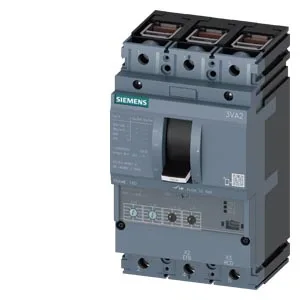
What this MCCB delivers
The Siemens SENTRON 3VA2110-5HN36-0KH0 is a 3-pole molded case circuit breaker rated for 100 A continuous current, with an ETU350 electronic trip unit configured for line protection. Its interrupting capacity hits 187 kA at 240 V, 121 kA at 415 V and 440 V, 79 kA at 500 V, and 4.25 kA at 690 V — so it handles high-fault scenarios at typical distribution voltages without cascading upstream. The ETU350 trip unit gives you adjustable thermal-magnetic or electronic protection curves, depending on the variant; here it's set for line (cable/feeder) protection. That means it clears overcurrents and short-circuits fast enough to protect downstream conductors, not just the breaker itself. It ships with a shunt trip (STL) release for remote tripping, plus 2 auxiliary switches and 1 trip alarm switch (HQ configuration) — enough to signal status back to a PLC or annunciator panel without adding external relays.
Sizing and thermal derating
The 100 A rating holds flat from 40 °C through 50 °C ambient. At 55 °C it derates to 96.25 A, at 60 °C to 92.5 A, at 65 °C to 88.75 A, and at 70 °C to 85 A. If your panel runs hot — say, near a drive stack or in a non-climate-controlled enclosure — size the load current against the derated figure, not the nameplate 100 A. Maximum power loss is 10 W. That's modest for a 100 A frame, but in a sealed enclosure with multiple breakers, it adds up — factor it into your thermal budget. Dimensions: 105 mm wide, 181 mm high, 86 mm deep. The 105 mm width is the standard 3-pole MCCB footprint for this SENTRON frame size — it drops into the same panel cutout as other 3VA2 breakers of the same rating.
Panel fit and wiring
Mounts on a DIN rail or direct-panel via the 3VA mounting base. The 86 mm depth leaves clearance for rear-connected busbars or cable lugs in a standard 200 mm deep enclosure. The shunt trip (STL) is wired separately from the main power path — it needs a control voltage to hold the breaker closed; removing voltage trips it. The auxiliary contacts (2 NO/NC + 1 trip alarm) are rated for standard control circuits and share the same terminal block.
