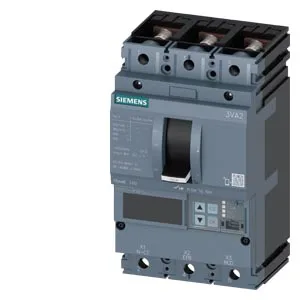
The Siemens SENTRON 3VA2110-5JP32-0HC0 is a 3-pole molded case circuit breaker rated for 100 A continuous current across the full ambient range from 40 °C through 70 °C — no derating needed up to that ceiling. Breaking capacity hits 187 kA at 240 V AC, 121 kA at 415 V and 440 V, then drops to 75.6 kA at 500 V and 3.7 kA at 690 V. That 187 kA figure at 240 V means it handles high-fault utility feeds or transformer secondaries where available short-circuit current is substantial; the 3.7 kA at 690 V still covers most industrial motor branch circuits at that voltage class. The 10 W maximum power loss is modest for a 100 A frame; panel ventilation is still advisable in a sealed enclosure.
The 86 mm depth includes the body and the rotary handle; allow clearance for cable bending radius behind the panel, especially with the shunt trip wiring and communication connector.
Breaking capacity by voltage — the so-what
At 500 V the breaker still manages 75.6 kA, which covers most 480 V North American panelboards. The steep drop to 3.7 kA at 690 V means this frame is not the right choice for 690 V systems with high fault current; for those, step up to a higher-rated 3VA frame.