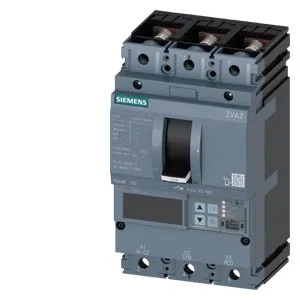
The key selection figure is the interrupting capacity: 187 kA at 240 V AC, 121 kA at 415 V and 440 V, 79 kA at 500 V, and 4.25 kA at 690 V. The ETU560 is a microprocessor-based overcurrent release with adjustable long-time, short-time, and instantaneous pickup settings, plus ground-fault protection via summation current sensing on the L-conductor. That ground-fault method sums the phase currents to detect imbalance — it catches arcing faults to ground without a separate neutral CT. Thermal derating starts at 55 °C: the breaker carries 100 A up to 50 °C, then drops to 96.25 A at 55 °C, 92.5 A at 60 °C, 88.75 A at 65 °C, and 85 A at 70 °C.
Auxiliary contacts and trip alarm — what's wired in
That's four discrete signal outputs from one breaker — enough to feed a PLC input card for status, trip, and alarm without adding a separate contactor or relay. The trip alarm switch changes state only on a fault trip (not manual open), so a maintenance team can distinguish a deliberate isolation from a short-circuit event. The integrated auxiliary trip module carries order code 3VA9608-0BB24.
That 86 mm depth includes the case body but not the handle throw or rear terminals — account for an extra 20–30 mm behind the panel for lug clearance and cable bend radius. The 105 mm width means it occupies three 35 mm DIN-rail modules (standard 17.5 mm per pole), so it fits a standard 600 mm wide enclosure with room for side-feed busbars.
As a Siemens SENTRON MCCB, this part carries IEC 60947-2 certification for molded case circuit breakers. The product designation and line protection version align with the standard's requirements for overcurrent protection in industrial distribution.