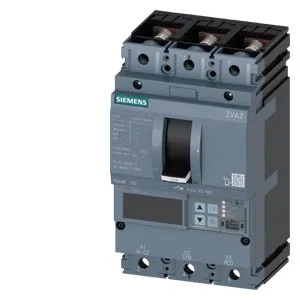
What this MCCB does on the line
The interrupting capacity is 187 kA at 240 V, 121 kA at 415 V and 440 V, 75.6 kA at 500 V, and 3.7 kA at 690 V. The UVR is a common requirement on safety circuits — if the control voltage drops, the breaker trips, preventing a motor from re-accelerating after a power dip. The communication function allows integration into a monitoring or energy-management system, so this breaker can report status and alarms over a bus rather than relying on hardwired pilot lights.
Spring-cage terminals accept 0.2–2.5 mm² solid or ferruled stranded; strip length 8 mm avoids whiskers under the cage.
What to know about the auxiliary release
The fitted undervoltage release (UVR) means the breaker trips when the control voltage falls below a threshold — typically 35–70% of rated voltage. If your application does not require a UVR (e.g., a UPS-backed circuit where you want the breaker to stay closed through a sag), you would order a variant without it. The auxiliary switch complement (2 aux + 1 trip alarm + 1 electrical alarm) provides enough dry contacts for remote status indication and a separate alarm for fault events.