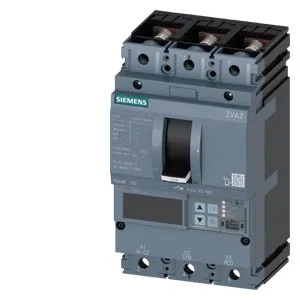
The Siemens SENTRON 3VA2110-5JQ32-0HA0 is a 3-pole molded case circuit breaker rated for 100 A continuous at 40 °C, flat across the full operating range up to 70 °C — no derating curve to chase for ambient temperature. It is designed for line protection (cable and busbar feeder duty), not motor branch protection, so the trip curve is sized for conductor thermal limits rather than motor inrush.
Breaking capacity across voltage — the real selection table
Interrupting capacity drops as system voltage rises: 187 kA at 240 V, 121 kA at 415 V and 440 V, 75.6 kA at 500 V, and 3.7 kA at 690 V. For 400 V class panels the 121 kA rating covers most utility transformer sizes without a current-limiting fuse ahead.
Integration notes — what fits where
The breaker occupies 105 mm width, 181 mm height, and 86 mm depth — a standard MCCB footprint for 100 A frames. The shunt trip release (STL) is integrated for remote tripping from an emergency-stop circuit or a supervisory PLC output. Communication function is onboard, so it can report status to a higher-level control system without an add-on module.