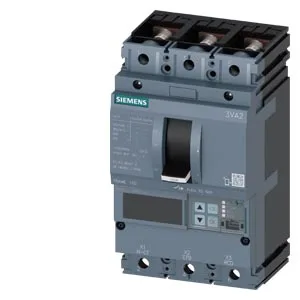
What this MCCB is and what it does
The Siemens 3VA2110-5JQ32-0KA0 is a SENTRON molded case circuit breaker (MCCB) rated for 100 A full-scale, built as a 3-pole unit for line protection duty. It's designed for main or feeder protection in distribution panels where you need adjustable thermal-magnetic or electronic trip curves — this variant includes a shunt trip release (STL) for remote tripping and a communication function for integration with monitoring systems. The 100 A rating holds flat across the full ambient range from 40 °C to 70 °C (–), so no derating is needed in a warm enclosure — that's unusual for a compact MCCB and simplifies panel thermal calculations.
Breaking capacity — what the numbers mean for fault protection
This breaker carries a 187 kA interrupting rating at 240 VAC, dropping to 121 kA at 415 V and 440 V, then 75.6 kA at 500 V, and 3.7 kA at 690 V. The steep fall at 690 V is typical for an MCCB with a 100 A frame — the arc extinction limits at higher voltage. For a 480 V panel (common in North America), the 121 kA at 440 V is the closest published figure; for 400 V systems (IEC world), the 121 kA at 415 V applies. That's a very high interrupting capacity for a 100 A frame — it can sit upstream of a high-fault transformer without needing a current-limiting fuse ahead of it.
Physical fit and panel integration
Dimensions are 105 mm wide, 181 mm tall, 86 mm deep — a standard 3-pole MCCB footprint for the SENTRON 3VA2 frame. It mounts via the rear screw terminals to a DIN rail or direct panel-mount plate. The 86 mm depth leaves clearance for rear-connected busbars in a typical distribution cabinet.
