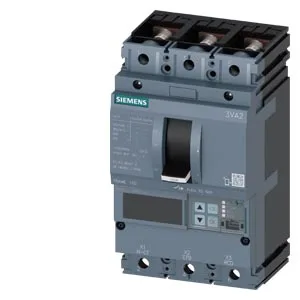
The adjustable thermal-magnetic trip is set to a full-scale value of 100 A with an initial minimum of 20 A, giving the commissioning engineer room to dial in the actual load without swapping the breaker body. Breaking capacity is the headline number for a MCCB: this unit delivers 187 kA at 240 V, 121 kA at 415 V and 440 V, 75.6 kA at 500 V, and 3.7 kA at 690 V. The steep drop to 3.7 kA at 690 V tells you this is a 240–500 V breaker; at 690 V it still clears but the fault-current window narrows significantly.
The 3-pole body with line-protection design (no undervoltage release fitted) means it installs as a straight feeder breaker; the integrated communication function allows remote monitoring or trip-status readback, which a facility engineer can wire into a BMS or SCADA loop without an add-on module. Power loss is rated at 10 W maximum — low enough that a standard IP2X enclosure with natural convection handles the heat without forced cooling, but worth verifying in a sealed, high-ambient cabinet if multiple breakers are ganged.